

Survey reveals officers have no confidence in ‘uninspiring’ senior leaders
The promotions process needs reforming so that the best policing leaders can be identified and developed, the Police Federation of England and Wales (PFEW) annual conference has been told.
Paul Matthews, the PFEW’s professional development lead, told conference that three-quarters of respondents to recent surveys said they had no confidence in their senior leaders and found them uninspiring.
He was speaking during a session on Leadership in Policing in which he said that failing leadership was “contributing towards the negative organisational culture where officers feel unsupported, demotivated and at times ostracised”.
Paul said: “There’s something fundamentally wrong with the current promotion process and the leaders that seem to breeze through it.
“Officers want leaders who are supportive, compassionate, loyal and inspiring. They want leaders that have sufficient policing pedigree to know what they’re doing, and to use this experience to lead by example, setting the tone and culture to drive up standards.
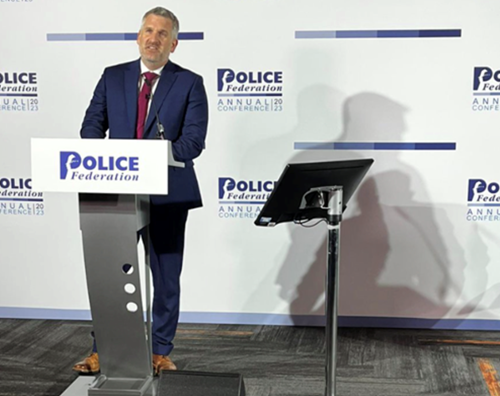
Paul Matthews, the PFEW’s professional development lead.
"They want leaders that will listen and adapt to ideas rather than simply driving through change for the sake of it, ignoring the views of those around them.
“Instead, we seem to have an ever-increasing portfolio of leaders that silently progress through the ranks by delegating downwards instead of challenging upwards. Leaders that have been rewarded not by their talents but by their ability to pass through a buzzword bingo promotion process and for not rattling cages along the way.
“It’s no surprise that we find in recent surveys that over three-quarters of police respondents say they have no confidence in their senior leadership and they find them uninspiring.
“I’m sure we can think of examples of computer systems that are too big to fail and short-lift projects that cost the earth and deliver very little but someone always seems to get promoted afterwards.”
Pointing to the Baroness Casey review, Paul said it highlighted that “leadership was not taken seriously and people were not promoted according to their talents, and if they were it was despite, not because of the promotion process”.
The review also found the absence of clear structures, systems expectations, and two-way communication allowed for poor cultures to grow, he said.
“We need to reform the promotion process to find and develop the best leaders if we’re to hope to change cultures and move forward as an organisation.”
He added: “When a sports team starts to fail, they change the formation and swap a couple of players. Eventually, if that doesn’t work, they replace the coaches and sack the manager.
"In policing, when we start to fail, it appears we keep the same manager and coaches and give them more power to just sack more players without knowing who they’re going to replace them with.”
Ray Clare, head of leadership and progression at the College of Policing, also took part in the session.
He said the college was concentrating on three priorities, helping to boost professionalism in policing, driving consistency across the 43 forces and improving and developing leadership skills of police officers and staff at all levels.
“In order to do that we’re bringing together all of our leadership development programmes, initiatives and services into one offering called the National Centre for Police Leadership,” he said.
“We want to set clear national standards for police leadership at all levels that will function as the national benchmark.
“We want to provide leadership development opportunities for everyone in policing. We want to develop the centre itself as a centre of excellence for building a positive leadership culture.”
Hot topics
Quick links to useful information: